Do you ever feel like you’re running on empty? You give so much to work, family, and daily responsibilities that there’s nothing left for you. This feeling of constant exhaustion and overwhelm is incredibly common.
Many people think self-care is selfish or indulgent. Maybe you’ve told yourself you don’t have time or that you’ll focus on yourself “someday.” But neglecting your own needs eventually catches up with you. It can lead to burnout, anxiety, and even physical health problems.
Here’s the truth: self-care isn’t a luxury. It’s a necessity for maintaining your mental wellness and overall health. The good news is that learning how to start a self-care routine is simpler than you might think.

It doesn’t require expensive spa days or long vacations. It starts with small, intentional daily habits.
In this guide, you’ll learn:
- What self-care really means
- Why it’s essential for your health
- A step-by-step plan to build your routine
- Practical tips to make it stick
- Common mistakes to avoid
Let’s get started on your wellness journey.
What is a Self-Care Routine?
A self-care routine is a set of intentional practices you do regularly to maintain and improve your physical, mental, and emotional health. It’s about taking active steps to care for yourself, just as you would care for someone you love.
Your self-care routine doesn’t need to be complicated. It can include simple things like getting enough sleep, eating nourishing foods, moving your body, and taking time to relax. It’s not about doing everything perfectly—it’s about consistently doing small things that support your well-being.
Think of your self-care routine as an essential part of your daily life, not an afterthought. When you have a consistent self-care routine for beginners or experts alike, you’re better equipped to handle life’s challenges.
Key Elements of a Good Self-Care Routine
- Consistency: It happens regularly, not just when you feel stressed.
- Intentionality: You do it on purpose, with the goal of caring for yourself.
- Flexibility: It adapts to your changing needs and circumstances.
- Simplicity: It includes sustainable habits you can maintain long-term.
Learning how to practice self-care means recognizing what you need and making time for those needs.
Why is a self-care routine important?
In our fast-paced world, it’s easy to prioritize everything and everyone above ourselves. But this pattern is unsustainable and damaging.
When you consistently neglect your own needs, the effects accumulate. You may experience:
- Chronic stress and anxiety
- Poor sleep quality
- Decreased energy levels
- Weakened immune system
- Difficulty concentrating
- Strained relationships
- Feelings of resentment or burnout
A consistent self-care routine acts as a protective factor. It helps you manage stress, build resilience, and maintain your energy.
Research from the American Psychological Association shows that regular self-care practices can significantly reduce stress and improve overall quality of life. It’s not just about feeling better—it’s about functioning better in all areas of life.
Self-Care as Preventative Health
Think of your self-care routine as a form of preventative medicine. Just as you brush your teeth daily to prevent cavities, your self-care habits help prevent more serious health issues down the road.
When you practice self-care regularly, you’re investing in your long-term health. You’re building the emotional and physical resources you need to thrive.
The Benefits of Daily Self-Care
Establishing a daily self-care routine offers numerous benefits. Here are some of the most significant ways it can improve your life:
Physical Health Benefits
- Better sleep quality and duration
- Reduced blood pressure and stress hormones
- Stronger immune system function
- Increased energy and vitality
- Better management of chronic conditions
Mental and Emotional Benefits
- Reduced anxiety and depression symptoms
- Increased self-esteem and self-worth
- Better emotional regulation
- Greater resilience to stress
- Improved mood and outlook
Cognitive Benefits
- Enhanced focus and concentration
- Better decision-making abilities
- Increased creativity
- Improved memory function
Social Benefits
- More patience in relationships
- Better boundaries with others
- Increased capacity for empathy
- Healthier communication patterns
As you can see, the benefits extend far beyond just feeling good. A consistent self-care routine for beginners can transform multiple aspects of your life.
Types of Self-Care: A Holistic Approach
Self-care isn’t one-size-fits-all. Different areas of your life require different types of care. A truly effective routine addresses multiple dimensions of wellness.

Here are the main types of self-care to consider when building your healthy self-care habits:
Physical Self-Care
Physical self-care involves activities that support your body’s health and function.
- Getting 7-9 hours of quality sleep
- Eating nutritious, balanced meals
- Staying hydrated throughout the day
- Moving your body regularly
- Taking breaks to rest and recover
- Attending medical appointments
Emotional Self-Care
Emotional self-care involves acknowledging and processing your feelings.
- Journaling about your thoughts and emotions
- Expressing yourself creatively
- Setting healthy boundaries
- Practicing self-compassion
- Allowing yourself to feel without judgment
- Saying “no” when you need to
Mental Self-Care
Mental self-care involves stimulating and caring for your mind.
- Reading for pleasure
- Learning new skills or hobbies
- Engaging in activities that challenge you
- Taking breaks from technology
- Practicing mindfulness or meditation
- Playing brain games or puzzles
Social Self-Care
Social self-care involves nurturing healthy relationships.
- Spending time with supportive friends and family
- Joining communities with shared interests
- Having meaningful conversations
- Setting boundaries in relationships
- Asking for help when you need it
Spiritual Self-Care
Spiritual self-care involves connecting with something larger than yourself.
- Practicing meditation or prayer
- Spending time in nature
- Engaging in reflective practices
- Exploring your values and purpose
- Participating in community service
A well-rounded routine includes activities from several of these categories. As you learn how to start a self-care routine, consider which areas need more attention in your life.
How to Start a Self-Care Routine in 7 Steps
Starting a new habit can feel overwhelming. But learning how to start a self-care routine doesn’t have to be complicated. Follow these seven simple steps to build a practice that works for you.
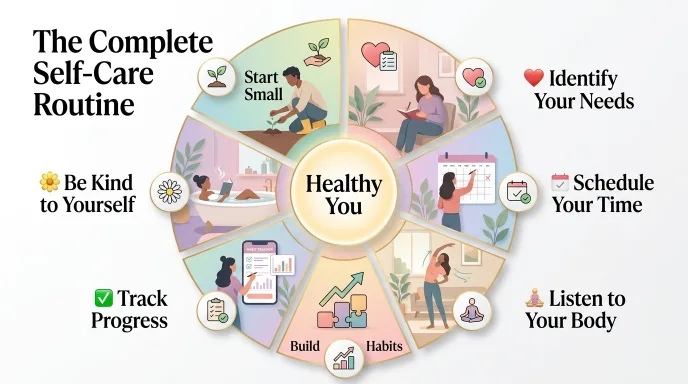
Step 1: Start Small and Simple
One of the biggest mistakes people make is trying to change everything at once. They decide to wake up at 5 AM, exercise for an hour, meditate, and meal prep—all starting tomorrow.
This approach rarely works. It’s too much change too quickly, and it often leads to burnout and giving up.
Instead, start with just one or two small habits. Choose something so simple you can’t say no. For example:
- Drink a glass of water when you wake up
- Take five deep breaths before getting out of bed
- Stretch for three minutes in the morning
- Write down one thing you’re grateful for each day
These small actions build momentum. Over time, you can gradually add more practices to your daily self-care routine.
Action Step: Choose ONE self-care habit to practice this week. Do it every day, no matter what.
Step 2: Identify Your Needs
To create an effective self-care routine, you need to understand what you actually need. This requires honest self-reflection.
Take a moment to ask yourself:
- What areas of my life feel neglected?
- When do I feel most stressed?
- What activities leave me feeling energized?
- What makes me feel drained?
- What did I enjoy doing before I became so busy?
Your answers to these questions will guide your self-care choices. Remember, your needs will change over time. Your routine should evolve with you.
Action Step: Write down three areas of your life that need more attention. Pick one simple action for each area.
Step 3: Schedule Self-Care Like an Appointment
If you don’t schedule it, it won’t happen. Self-care needs to be non-negotiable, just like any important commitment.
Look at your calendar and block out time for your self-care activities. Even 10-15 minutes a day makes a difference. Treat this time as sacred—don’t cancel it unless there’s a true emergency.
Consider these scheduling strategies:
- Morning routine: Start your day with self-care before demands pile up
- Lunch break: Use part of your break to recharge
- Evening wind-down: End your day with relaxation practices
- Weekend sessions: Use weekends for longer self-care activities
Consistency matters more than duration. Five minutes every day is better than an hour once a week.
Action Step: Schedule your self-care time for the next seven days. Put it in your calendar with a reminder.
Step 4: Listen to Your Body and Mind
Your body and mind are constantly giving you signals about what they need. The key is learning to listen.
When you’re tired, your body is asking for rest. When you’re irritable, you might need time alone. When you feel overwhelmed, it’s a sign to slow down.
Pay attention to:
- Physical sensations: fatigue, muscle tension, headaches
- Emotional signals: irritability, sadness, anxiety
- Mental cues: brain fog, difficulty focusing
- Behavioral changes: procrastination, overeating, withdrawal
Your self-care routine should be responsive to these signals. If you need extra rest, allow it. If you need to move your body, do it.
Action Step: Practice checking in with yourself three times today. Ask: “What do I need right now?”
Step 5: Build Your Routine Gradually
Once you’ve started with one or two habits, gradually add more. The key is to build your routine slowly and sustainably.
Here’s a sample progression:
- Week 1: Drink water upon waking; take 5-minute breaks
- Week 2: Add 5 minutes of stretching or walking
- Week 3: Add 5 minutes of journaling or meditation
- Week 4: Add 10 minutes of reading or a hobby
- Week 5: Review and adjust your routine
This gradual approach prevents overwhelm and increases the chances of habit formation.
Action Step: Plan what you’ll add to your routine next month. Write it down and set a start date.
Step 6: Track Your Progress and Adjust
Self-care isn’t static. What works today might not work next month. Regular reflection helps you stay on track.
Keep it simple with a weekly check-in:
- What self-care activities did I do this week?
- How did I feel overall?
- What worked well?
- What didn’t work?
- What needs to change?
Tracking can be as simple as using a journal, an app, or a simple checklist. The goal is to stay aware of your habits and their effects.
Action Step: Schedule a 10-minute weekly review for the next four weeks. Use this time to assess and adjust your routine.
Step 7: Be Kind to Yourself When You Miss a Day
Nobody is perfect. There will be days when you can’t do your full self-care routine. That’s completely normal and okay.
When you miss a day (or several days), don’t spiral into self-criticism. Guilt and shame won’t help you get back on track.
Instead:
- Acknowledge it without judgment
- Reflect on what got in the way
- Plan how to overcome that obstacle next time
- Get back to your routine as soon as possible
Your self-care journey is a marathon, not a sprint. Each day is a new opportunity to care for yourself.
Action Step: Write yourself a compassionate note for when you miss a day. Put it somewhere you’ll see it.
Best Practices for Building Self-Care Habits
Now that you know how to start a self-care routine, let’s explore best practices that increase your chances of success.
Start Your Day Intentionally
How you start your morning sets the tone for the entire day. Instead of immediately checking your phone, try these healthy self-care habits:
- Stay in bed for a few extra moments of quiet
- Practice gratitude
- Stretch or do light movement
- Set an intention for the day
Even five minutes of intentional morning practice can shift your whole day.
Create a Self-Care Space
Designate a specific space in your home for relaxation. It doesn’t need to be large—just a corner with a comfortable chair, some plants, and calming colors works well.
Make this space off-limits for work, screens, and stress. Use it only for restorative activities like reading, journaling, or meditation.
Connect with Others
Self-care doesn’t have to be solitary. Many people find connection and support through group activities.
Consider:
- Exercise classes or walking groups
- Book clubs or discussion groups
- Meditation or yoga communities
- Volunteer opportunities
Social connection is a vital part of your wellness journey.
Unplug Regularly
Technology is a major source of stress and distraction. Set boundaries around your screen time.
Try these digital self-care practices:
- No screens for the first hour after waking
- No screens for the last hour before bed
- Scheduled breaks from social media
- Turn off notifications during self-care time
Give Yourself Grace
Self-care is about progress, not perfection. Some days your best will look different from others. Honor where you are and do what you can.
Common Self-Care Mistakes to Avoid
As you learn how to practice self-care, it’s helpful to be aware of common pitfalls. Avoiding these mistakes will increase your chances of success.
Mistake 1: Making It Too Complicated
Many people think self-care requires elaborate spa days or expensive treatments. This misconception keeps people from starting at all.
The Fix: Self-care can be simple and free. A five-minute walk, deep breathing, or calling a friend all count as self-care.
Mistake 2: Thinking It’s Selfish
The belief that self-care is selfish is one of the biggest barriers. This is especially common among parents, caregivers, and people in helping professions.
The Fix: You cannot pour from an empty cup. Taking care of yourself allows you to be more present and helpful to others.
Mistake 3: Ignoring Your Own Preferences
Your self-care routine should reflect what You enjoy. Copying someone else’s routine won’t work if it doesn’t resonate with you.
The Fix: Experiment with different activities and keep what works. Your routine should feel nourishing, not like a chore.
Mistake 4: Being Inconsistent
Inconsistency is one of the main reasons self-care doesn’t work. Doing it once in a while doesn’t produce the same benefits as a regular practice.
The Fix: Start small and aim for daily consistency. Even a few minutes each day is more effective than an hour once a month.
Mistake 5: Not Adjusting When Needed
Life changes, and your self-care needs change with it. What worked when you were single might not work when you have children.
The Fix: Regularly review and adjust your routine. Be willing to try new approaches as your circumstances evolve.
Mistake 6: Treating It as a Reward
Self-care isn’t something you earn after being productive. It’s an essential part of your well-being that shouldn’t be conditional.
The Fix: Make self-care a non-negotiable part of your daily life, not something you do only when you’ve “earned” it.
Expert Tips for Long-Term Success
These insights from wellness professionals can help you maintain your healthy self-care habits for the long term.
Tip 1: Use Habit Stacking
Habit stacking means attaching a new habit to an existing one. This technique makes it easier to remember and stick with new practices.
Examples:
- After brushing your teeth, do 10 deep breaths
- With your morning coffee, write down one thing you’re grateful for
- After using the bathroom, do three stretches
- Before eating lunch, take a three-minute mindfulness break
Tip 2: Know Your Energy Cycles
We all have times of day when we have more energy. Pay attention to your natural rhythms and schedule your self-care accordingly.
Some people do best with morning self-care. Others prefer evening relaxation. There’s no right or wrong—only what works for you.
Tip 3: Create a Self-Care Menu
A self-care menu is a list of activities you can choose from based on your needs. It’s particularly helpful when you’re feeling stressed but don’t know what you need.
Your menu might include:
- 5-minute activities: deep breathing, stretching, listening to a song
- 15-minute activities: short walk, quick journaling, calling a friend
- 30-minute activities: exercise class, meal prep, reading
- 60-minute activities: bath, long walk, creative project
Having a menu eliminates the decision fatigue of figuring out what to do.
Tip 4: Find Accountability
Having someone to support you can help you stay consistent.
Ways to build accountability:
- Share your goals with a trusted friend
- Join a support group or community
- Work with a coach or therapist
- Use an app that tracks your habits
Tip 5: Practice Mindfulness Throughout the Day
You don’t need to meditate for 30 minutes to benefit from mindfulness. Short, frequent practices can be just as helpful.
Try these micro-practices:
- Take three mindful breaths before starting a new task
- Notice five things you can see when you step outside
- Feel the sensation of water on your skin during a handwash
- Listen fully to a song without multitasking
What Research Says About Self-Care
Scientific research supports the importance of self-care for both mental and physical health. Here are some key findings:
Stress Reduction
Studies show that regular self-care practices reduce the body’s stress response. The National Institutes of Health (NIH) reports that activities like meditation and deep breathing can lower cortisol levels, the body’s primary stress hormone.
Improved Mental Health
Research from the American Psychological Association indicates that self-care practices are associated with lower rates of anxiety and depression. Regular self-care builds emotional resilience and helps regulate mood.
Better Physical Health
The CDC emphasizes that lifestyle factors including sleep, nutrition, and physical activity are critical for preventing chronic diseases. Self-care routines that include these elements support long-term physical health.
Enhanced Immune Function
According to research published in the journal Psychosomatic Medicine, stress reduction techniques can boost immune function. People who practice stress management regularly tend to get sick less often.
Longevity
Studies suggest that people who practice consistent self-care live longer, healthier lives. The combination of healthy habits including stress management, regular movement, and good sleep—adds years to life.
Sleep Quality
The Sleep Foundation emphasizes that a consistent bedtime routine improves sleep quality. Good sleep is one of the most important aspects of any self-care routine.
Social Connection
Research shows that social connection is as important as diet and exercise for health. People with strong social support have lower rates of chronic disease and live longer.
Real-Life Examples of Simple Self-Care Routines
Seeing how others approach their self-care routine for beginners can be inspiring. Here are some real-life examples from people who’ve built consistent practices.
Example 1: The Busy Professional
Sarah is a marketing manager with a demanding job and two children. Her routine focuses on small moments:
- Morning: 5 minutes of stretching while coffee brews
- Lunch break: 10-minute walk outside, no phone
- Evening: 15 minutes of reading before bed
- Weekly: One hobby activity, like painting or gardening
Sarah says, “I used to think I didn’t have time for self-care. Now I realize I can’t afford not to do it. Those small moments keep me grounded.“
Example 2: The Young Adult
Marcus is a recent college graduate navigating his first job. His routine is centered on wellness habits:
- Morning: Meditation using an app for 10 minutes
- Work day: Stretch breaks every 2 hours
- Evening: Cooking a healthy meal instead of ordering takeout
- Weekly: Exercise classes with friends
Marcus says, “Building healthy self-care habits early has helped me manage stress. I feel more in control of my life.”
Example 3: The Caregiver
Linda is a full-time caregiver for her aging mother. Her routine prioritizes her own well-being:
- Morning: 10 minutes of journaling before her mother wakes
- Throughout the day: Deep breathing when overwhelmed
- Evening: 30 minutes of time for herself—usually a bath or phone call with a friend
- Weekly: One afternoon off for rest, with respite care
Linda says, “I was burning out until I realized I needed to care for myself too. Now I have more patience and energy for my mother.”
Example 4: The College Student
Maria is a university student balancing classes, work, and social life. Her routine keeps her mentally well:
- Morning: Taking time to eat a proper breakfast
- Between classes: Short walks across campus
- Study sessions: Taking 5-minute breaks every hour
- Evening: Drawing or listening to calming music
Maria says, “I used to study until I couldn’t focus anymore. Now I’m more productive because I take regular breaks.”
Self-Care Myths vs. Facts
Many misconceptions about self-care prevent people from starting. Let’s clear up some common myths.
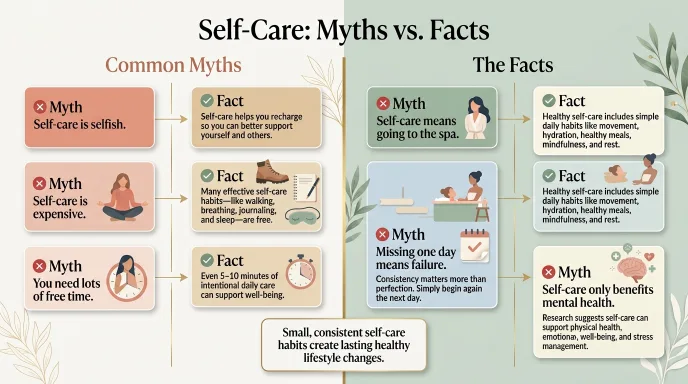
Myth 1: Self-Care Is Selfish
Fact: Self-care is necessary for being able to care for others. When you prioritize your well-being, you have more energy and patience for relationships.
Myth 2: Self-Care Requires Money
Fact: Many self-care practices are free or low-cost. Deep breathing, walking, journaling, and connecting with loved ones cost nothing.
Myth 3: Self-Care Is Time-Consuming
Fact: Self-care can be as short as five minutes. Small, consistent practices are more effective than sporadic long sessions.
Myth 4: Self-Care Is Only for People with Mental Health Issues
Fact: Self-care is beneficial for everyone. It’s a preventative measure that supports overall health and well-being.
Myth 5: Self-Care Is Always Relaxing
Fact: Some self-care practices are challenging, like exercise or setting boundaries. They may not feel relaxing in the moment but serve your long-term well-being well.
Myth 6: Self-Care Is the Same as Being Lazy
Fact: Self-care is intentional and purposeful. It’s about restoring yourself so you can function at your best.
Frequently Asked Questions
1. What is the best way to start a self-care routine?
Start small. Choose one simple habit and practice it daily for a week. Add more habits gradually. Consistency matters more than intensity.
2. How much time should I spend on self-care each day?
Even 5-10 minutes daily can make a difference. The key is consistency, not duration. Start with what feels manageable and increase slowly.
3. What are the best self-care activities for beginners?
Begin with simple activities like deep breathing, short walks, drinking water, stretching, or taking a few minutes to read or relax.
4. How do I make self-care a habit?
Use habit stacking, schedule it into your day, and start small. Consistency and intention are more important than perfection.
5. What if I miss a day of self-care?
Be kind to yourself. Missing a day is normal and expected. Just get back to your routine the next day without judgment.
Conclusion
Learning how to start a self-care routine is one of the most important investments you can make in yourself. It’s not about being perfect or having everything figured out. It’s about showing up for yourself, day by day, in small and meaningful ways.
Remember, your self-care journey is unique to you. What works for someone else may not work for you. Trust yourself to find the practices that nourish your body, mind, and spirit.

The best time to start was yesterday. The second best time is now. Choose one small action today and take the first step on your wellness journey. Your future self will thank you.
Ready to Start Your Self-Care Journey?
Take five minutes right now to choose one simple self-care practice to try today. Write it down, commit to it, and see how it feels. You deserve to feel your best.
Medical Disclaimer
The information provided in this article is for educational and informational purposes only and is not intended as medical advice. Always consult with a qualified healthcare provider regarding any health concerns or before starting any new health regimen. This content does not replace professional medical advice, diagnosis, or treatment.

Hi, I’m Noah Richardson, the content writer behind LaxiBoost. I write about self-care and personal well-being to help people build healthier and more balanced lives. My goal is to turn trusted information, easy-to-follow advice that anyone can apply in daily life.
I believe self-care is more than an occasional activity it’s a lifelong habit that supports both mental and physical well-being. Through my articles, I share simple strategies, practical tips, and research-based insights to help you reduce stress, improve your daily routine, and take better care of yourself with confidence.
Thank you for reading LaxiBoost. I hope my content helps you create healthier habits and enjoy a happier, more balanced lifestyle.